How BC Construction Turned Pipeline Chaos into 3x Real Growth
The employee-owned national GC went from spreadsheet chaos and an untrustworthy pipeline to 3x real growth in two years, with 100% Go/No-Go compliance and zero late RFPs.

Michael Sullivan
Senior Growth Marketer

Company Background
BC Construction Group (BCCG) is a 100% employee-owned national general contractor specializing in highly focused market verticals: warehousing, manufacturing, R&D facilities, and charter schools. Founded approximately 16 years ago as a traveling organization, BCCG has grown from a founder-led startup into a second-generation leadership team with a $250M+ annual sales target, and a fully decentralized BD team spanning Salt Lake City, Michigan, Pennsylvania, and South Carolina.
As an ESOP, every investment BCCG makes is the team’s money. That raised the stakes on every technology decision, and made the results of getting Buildr right all the more meaningful.
The Breaking Point: Shaky Data, Unaccountable BD, Skeptical Leadership
I didn’t know if my pipeline was real or fiction. It was that bad.
For a company built on precision in the field, BCCG’s back office was running on gut feel. The business was growing, the client list was blue-chip, but the systems behind the scenes hadn’t kept pace. Three previous CRM implementations had come and gone, each one abandoned before it could take hold. By the time Adam Chafe stepped into the EVP role, the organization had CRM fatigue and zero trust that technology could help.
BCCG was running entirely on Excel: separate pursuit sheets for BD, separate tracking for precon, no connection between the two. Forecasting was “entirely unbelievable.” Adam sat in Monday sales meetings every week unable to trust what he was hearing.
The crisis came to a head with a single BD employee whose reported pipeline was roughly 5x what was real. After the employee left, Adam personally called every owner. Less than one-fifth of the claimed opportunities had any chance of closing. Multiple owners had never spoken to this person about the project at all.
Benjamin Klaver, coming in as Director of Marketing without a construction background, was trying to manage proposals, leads, and project tracking simultaneously, working off spreadsheets where half the fields were blank and the data was whatever people felt like entering.
“I didn’t know who the client contact was. I didn’t know the anticipated project value. I didn’t even know what state it was being built in,” Benjamin said.
The spreadsheets weren’t just inaccurate — they were actively dangerous. Leadership was making staffing decisions, resource commitments, and board presentations based on numbers that had no relationship to reality. Adam identified three non-negotiables for any solution:
- Risk management
- A single source of truth
- Legitimate market intelligence
Spreadsheets delivered none of them.
They didn't outbid you.
They out-prepared you.
GCs who centralize pursuit data win more work. Buildr makes that easy.
The Search: Why Generic CRMs Couldn’t Cut It
BCCG evaluated Salesforce and HubSpot. They actually piloted HubSpot with a BD team member who had experience with it.
The verdict was clear. “It fit one box: the BD box. For precon, for tracking, for where clients are in the process, it had none of those needs,” Benjamin said.
Adam had spent his career at Fortune 200 companies spending six figures a year on CRM platforms, plus $150K/year on third-party integrators just to customize them for how their business worked. He knew the cost of forcing a generic tool into a construction workflow. His biggest fear going into the search: BCCG would need to spend at that level too.
The revelation surprised even a veteran: “I didn’t know construction-specific CRM systems even existed. And I’ve been doing this for 35 years,” Adam said.
The great irony, as Adam later put it: “The least expensive solution has been the one that enabled us the most.”
The industry-specific nature of Buildr is the compelling promise. They nailed it at concept.
Implementation: Faster and Easier Than Anyone Expected
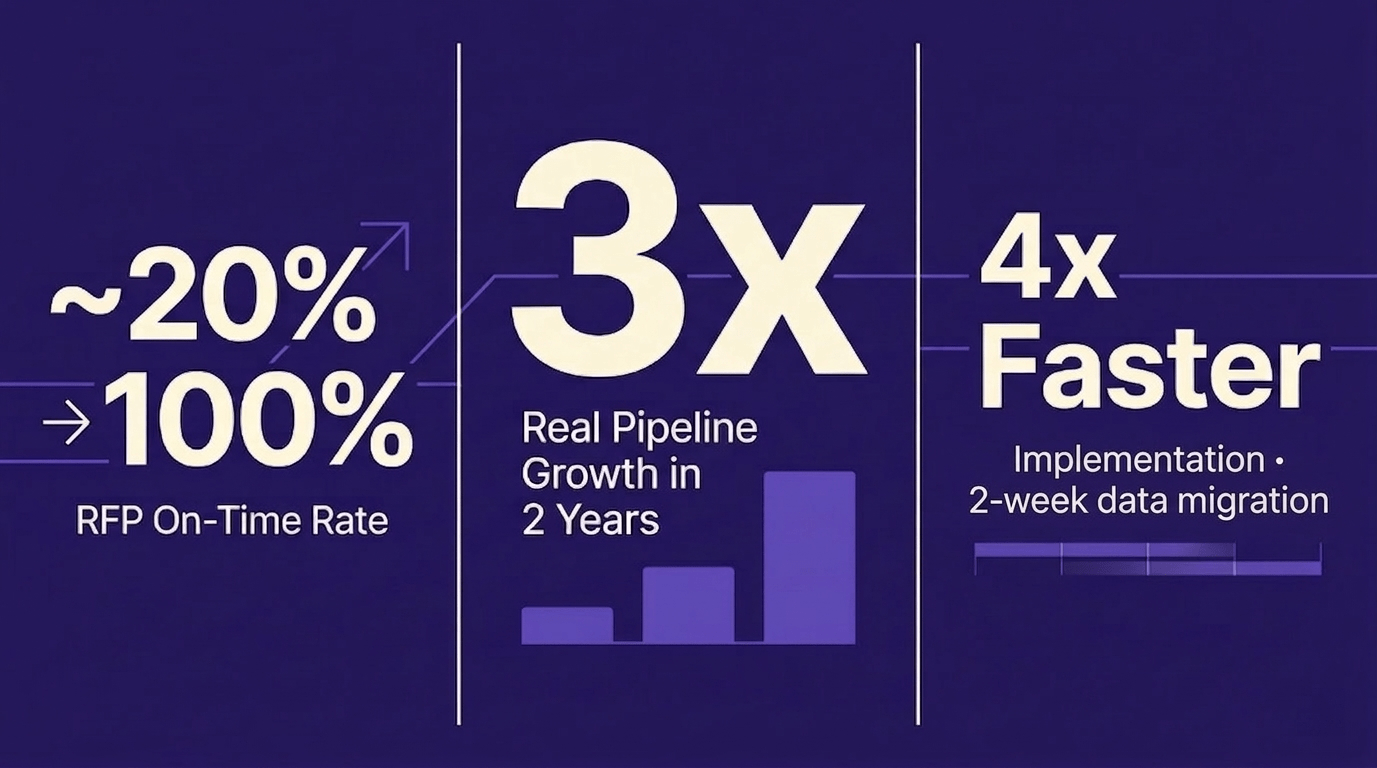
BCCG had a formal 4-quarter implementation plan covering BD, Precon, Finance, and Operations. Benjamin completed 90% of it in Q1, finishing 4x faster than planned.
Full data migration from spreadsheets to Buildr took two weeks. Adam had braced for it to be “an almost insurmountable hurdle.”
Clear ownership rules were established from the start: once a project hits P6 (production/RFP phase), Precon owns the data, not BD. No ambiguity, no overlap.
The toughest group to win over was Precon. “They are finicky. They are the last people to buy in. They don’t like change,” Adam said. They adopted anyway, and started asking for features.
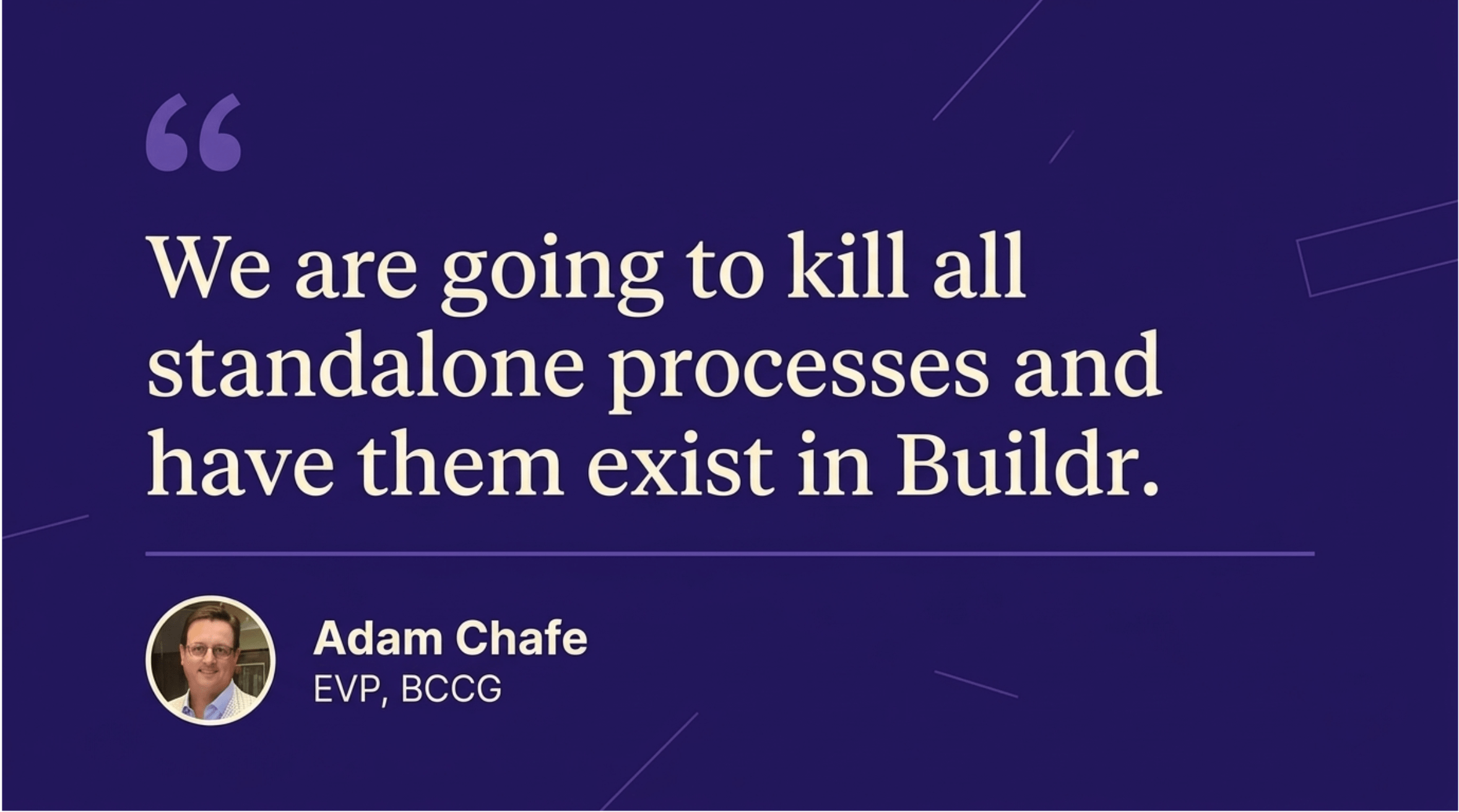
BCCG had been using a standalone Go/No-Go tool. They ran a side-by-side comparison with Buildr’s built-in feature. In two meetings, they replicated everything they valued. The standalone tool was retired.
One Source of Truth: Ending the Monday Morning War
Every quarter, Adam and the CEO would have a “passionate debate” over the book-of-sales number. Adam was looking at CRM. The CEO was looking at the Precon log. Both were confident. Neither was right.
That argument no longer exists. They pull up one screen. The number is the same. “We’ve never had this conversation since,” Adam said.
The bi-weekly alignment meeting between Adam and the VP of Precon, held specifically to manually reconcile project numbers before board reports, was eliminated entirely.
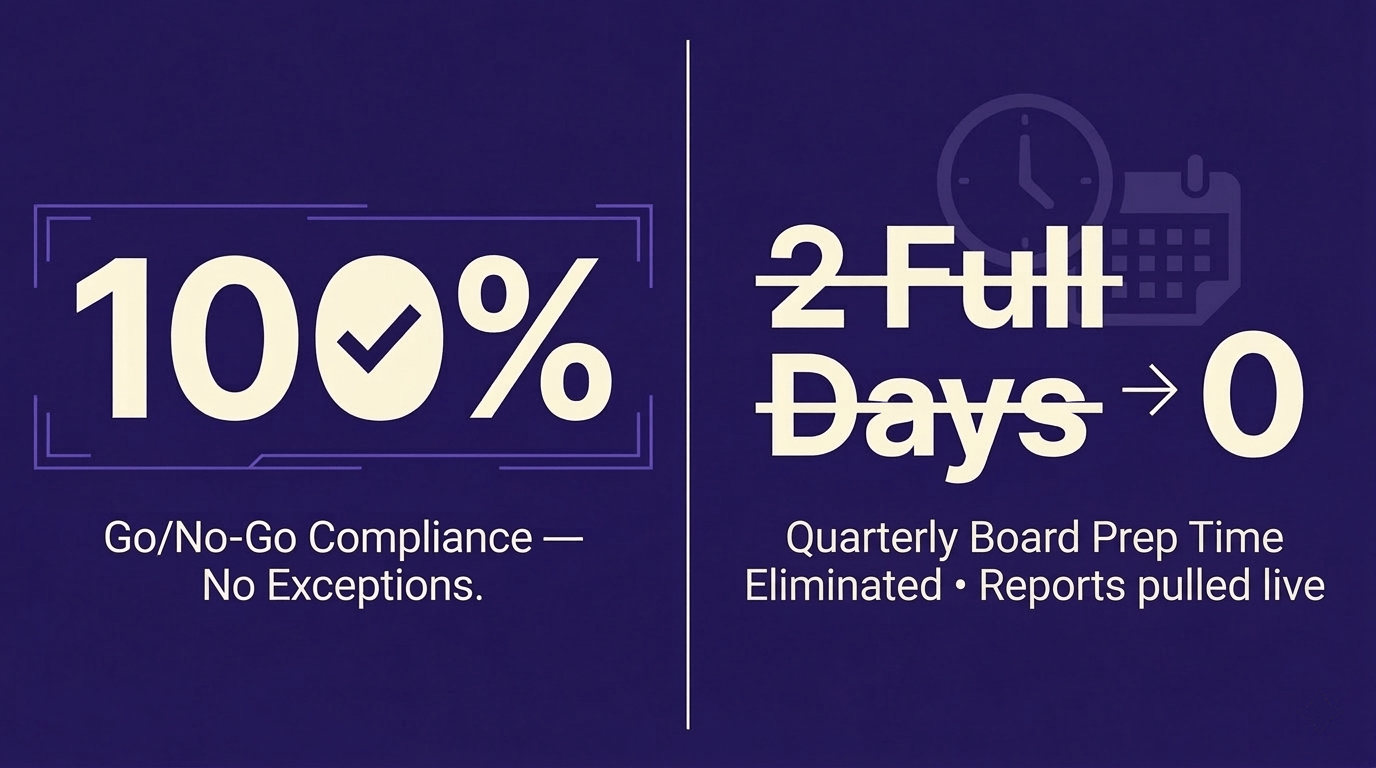
Board reporting reclaimed two full days per quarter that were previously spent compiling presentation content. Benjamin saved multiple hours per week just tracking down basic information that now lives in one place. Before Buildr, pulling historical project data meant calling VPs who answered from memory, with no way to verify accuracy. Subcontractor history, project values, timelines: all locked in people’s heads.
When everyone looks at the same data, the debates stop and the decisions start.
From Patchy to Perfect: Go/No-Go and RFP Discipline
Go/No-Go compliance went from inconsistent to 100%. No project gets resourced without a completed score. “We never miss,” Adam said.
The transformation in RFP submissions was even more dramatic.
As recently as Q3 of last year, I would say 80% of our RFPs were not submitted on time. The first quarter of this year, we were 100% on time. And it wasn’t a light quarter.
The old process: a separate weekly meeting with divisional leaders to manually track what was due. Dates would change after the meeting and nobody would update anyone. Benjamin would stay until 9pm working on proposals that had already been pushed.
Now the calendar is live, everyone sees the same dates, and the meeting is gone.
The Pipeline Purge: Smaller, Realer, Three Times Bigger
Before Buildr, BCCG’s reported pipeline was mostly fiction. After an honest purge, the real number was a fraction of what had been claimed.
Some business units saw their pipeline shrink by 75% overnight. That was celebrated, not mourned.
I loved it when certain business units’ pipelines dropped to a quarter of what they’d been reporting, because we just proved to ourselves it’s not real. We made the changes we needed. Let’s start over. And then everything that goes in now is real.
Today, BCCG’s trusted pipeline has grown 3x in two years, with a fundamentally different level of confidence in every single number.
The data is now unemotional: if a project slips, it moves phases. No politics, no memory, no debate.
The Cultural Shift: Adam’s 5 Rules for CRM That Actually Sticks
Adam’s view is direct: CRM failures are almost always a leadership accountability failure, not a software failure. Here’s the framework BCCG used to make it stick.
1. Burn the boats. Kill backup systems as fast as possible. Don’t let spreadsheets live alongside the new platform. “If you won’t do the work yourself, don’t do it. You’re going to lose the money.”
2. Migrate the data, but make everyone do it themselves. Full migration took two weeks, but the rule was clear: no one hands off data entry to an admin. Everyone owns their data. “You have to eat what you cook.”
3. Run your sales meetings out of it. No other agenda, no other mechanism. Open Buildr and go. Every Monday, that’s the only source.
4. Engage every functional team. Precon, Finance, Operations: everyone’s in. It’s non-negotiable. Benjamin’s litmus test for adoption: when people start asking for features, they like it.
5. The CEO has to visibly live it. At BCCG, the CEO reviews his Buildr report every single week before the staff meeting — submissions to the day, award dates to the day, contract values to the dollar. Nobody can hide from that. Adam, as EVP, personally entered 15 new contacts last week for a targeted campaign. “The work’s not hard. The system’s too easy to use,” he said.
Results
| Metric | Before Buildr | After Buildr |
|---|---|---|
| Pipeline value (trusted) | x (baseline) | 3x growth in 2 years |
| RFP on-time rate | ~20% | 100% on time |
| Go/No-Go compliance | Patchy / inconsistent | 100%, no exceptions |
| Board prep time | 2 full days per quarter (manual) | Eliminated; reports pulled live |
| Data migration timeline | Expected: months | Actual: 2 weeks |
| Implementation timeline | Planned: 4 quarters | Actual: 90% done in Q1 |
| Weekly alignment meetings | Bi-weekly manual reconciliation | Eliminated |
| Pipeline accuracy | ~20% | 100% trusted |
The Relationship: Why It’s Not Just Software
Unlike enterprise CRM vendors that hand you off after the sale, BCCG’s experience with Buildr stayed personal. Adam singled out their account rep unprompted: “The best thing you guys have going is your people.” No escalation chains, no ticket queues. Their rep goes straight to Benjamin, who vets every idea and routes it internally.
Benjamin has submitted product feedback that’s been implemented. “That’s something you’d never get from Salesforce or HubSpot,” he said. The Buildr team checks in regularly, keeping the relationship active beyond just the sales cycle.
When asked what’s next, Adam pointed to workforce planning, better task delegation, and AI-powered features for sales activation, call prep, and report building. The platform isn’t a finished purchase. It’s a growing investment.
Final Verdict
Adam and his president recently asked each other: what are we most proud of in our tenure? Buildr implementation was number two on the list, behind only landing and scaling their largest client.
“This is tech. It’s sticky now. It will continue when we’re gone because it’s systematized,” Adam said.
What would Adam tell a GC still on spreadsheets? “If they compete in the markets that we do, I’d tell them to keep doing that.” He laughed, then got serious: “I don’t know how you scale and grow and feel confident you’re headed in the right direction without this type of killer application. I just don’t know how you do it.”
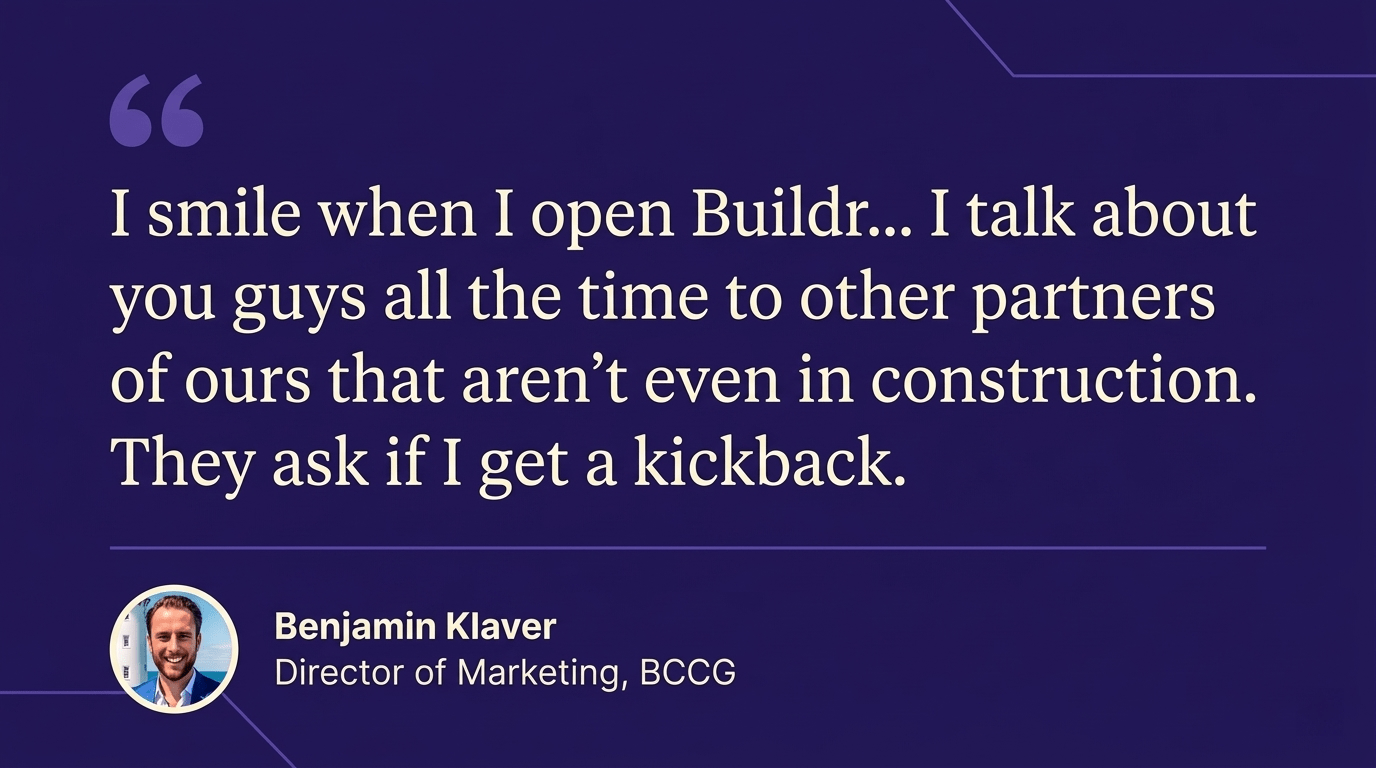
Benjamin’s take is simpler: “I smile when I open Buildr.” There hasn’t been a single negative comment from the team in 18 months of company-wide, unlimited seat use.
Ten years from now, I can’t imagine walking away from it to a different product. You installed the Coke machine — you created the annuity.